Monolith vs Microservices: Concepts, Challenges, and Use Cases
Understanding Scalability, Trade-offs, and Real-World Adoption

As software systems grow in size and complexity, architectural decisions become critical. Two of the most widely discussed approaches today are Monolithic Architecture and Microservices Architecture. While both have their own place in system designs, choosing the right one can significantly impact scalability, development speed, and long-term maintainability.
Let’s explore these architectures in a simple, practical way - along with real-world examples from Netflix and Amazon.
What is Monolithic Architecture?
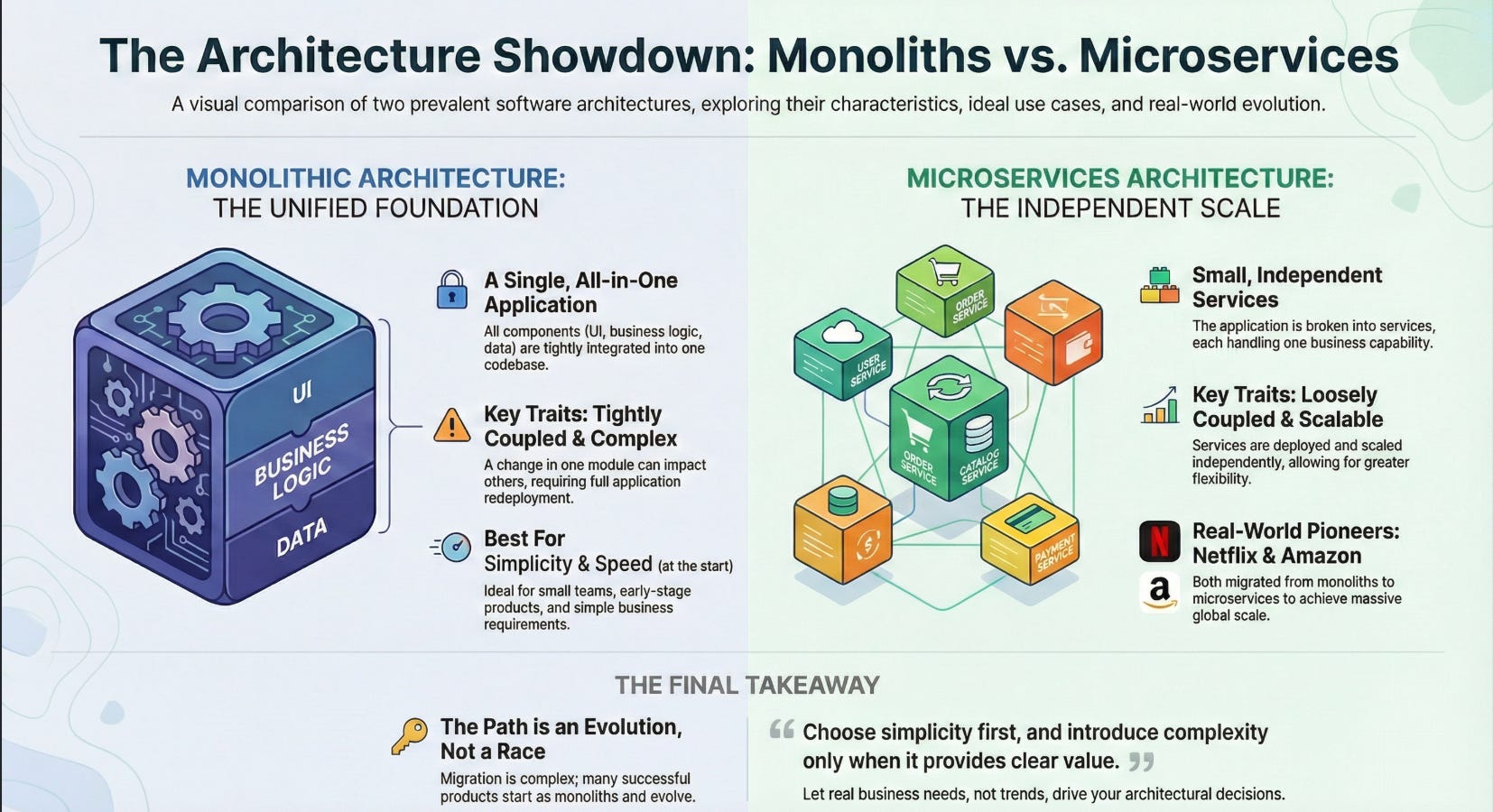
A monolithic architecture is built as a single, unified application where all components—UI, business logic, and data access—are tightly integrated.
In a monolithic system, modules like authentication, order processing, payments, and inventory reside in the same codebase and are deployed together.
Key Characteristics:
Tightly coupled components
A change in one module can impact others.
Large and complex codebase
As features increase, the application becomes harder to understand and maintain.
Difficult to manage and deploy
Even small changes require full application testing and deployment.
Limited scalability
The entire application must be scaled, even if only one feature is under heavy load.
When Monoliths Work Well:
Small teams
Early-stage products
Simple business requirements
Many successful applications start as monoliths because they are easier to build and deploy initially.
What is Microservices Architecture?
Microservices architecture breaks an application into small, independent services, each responsible for a specific business capability.
Each microservice:
Has its own codebase
Can be deployed independently
Often has its own database
Communicates with each other via APIs or events
Key Characteristics:
Loosely coupled services
Independent scaling
Faster and safer deployments
Technology flexibility
For example, if a payment service experiences heavy traffic, it can be scaled independently—without affecting the rest of the system.
Real-World Example: Netflix
Netflix is a prime example of microservices adoption.
Initially, Netflix used a monolithic architecture, but as its user base grew globally, the system struggled with scalability and availability. To solve this, Netflix migrated to microservices running on AWS.
What Netflix Achieved:
Independent scaling of services like recommendations, streaming, and user profiles
Better fault isolation (a failure in one service doesn’t bring down the platform)
Faster innovation and deployments
Netflix also used tools for observability, such as distributed tracing and centralized monitoring, which are essential for managing microservices at scale.
Real-World Example: Amazon
Amazon’s journey to microservices started with a famous internal mandate by Jeff Bezos:
“All teams must expose their data and functionality through service interfaces.”
This decision forced Amazon to break its monolithic systems into services aligned with business capabilities like:
Order Management
Payments
Inventory
Shipping
Benefits Amazon Gained:
Teams could work independently
Faster feature delivery
Massive scalability during peak traffic (e.g., Black Friday sales)
Today, Amazon’s microservices approach is one of the key reasons it can handle millions of transactions reliably.
Challenges in Moving from Monolith to Microservices
Migrating to microservices is not easy and comes with challenges:
Service Decomposition
Identifying correct service boundaries is difficult.
Tight Coupling Risks
Poor design can lead to a “distributed monolith.”
API Contract Changes
If a service response format changes, dependent clients may fail.
Transaction Management
Distributed transactions are complex.
Rollbacks across multiple services are difficult.
A failure in one service database can leave the system in an inconsistent state.
To handle this, patterns like the Saga Pattern and eventual consistency are commonly used.
How Small Should a Microservice Be?
There’s no fixed rule, but a good microservice:
Handles one clear business responsibility
Can be owned by a single team
Can be deployed independently
If services become too small, complexity increases rather than decreases.
Final Thoughts
Monolithic and microservices architectures are not enemies—they are tools.
Many organizations start with a modular monolith and gradually evolve into microservices as scale and complexity demand it.
Netflix and Amazon didn’t adopt microservices overnight. They evolved thoughtfully, driven by real business needs.
Choose simplicity first, and introduce complexity only when it provides clear value.